
Employability Skills Assessment: What Students Should Know
Employability Skills Assessment: What Students Should Know
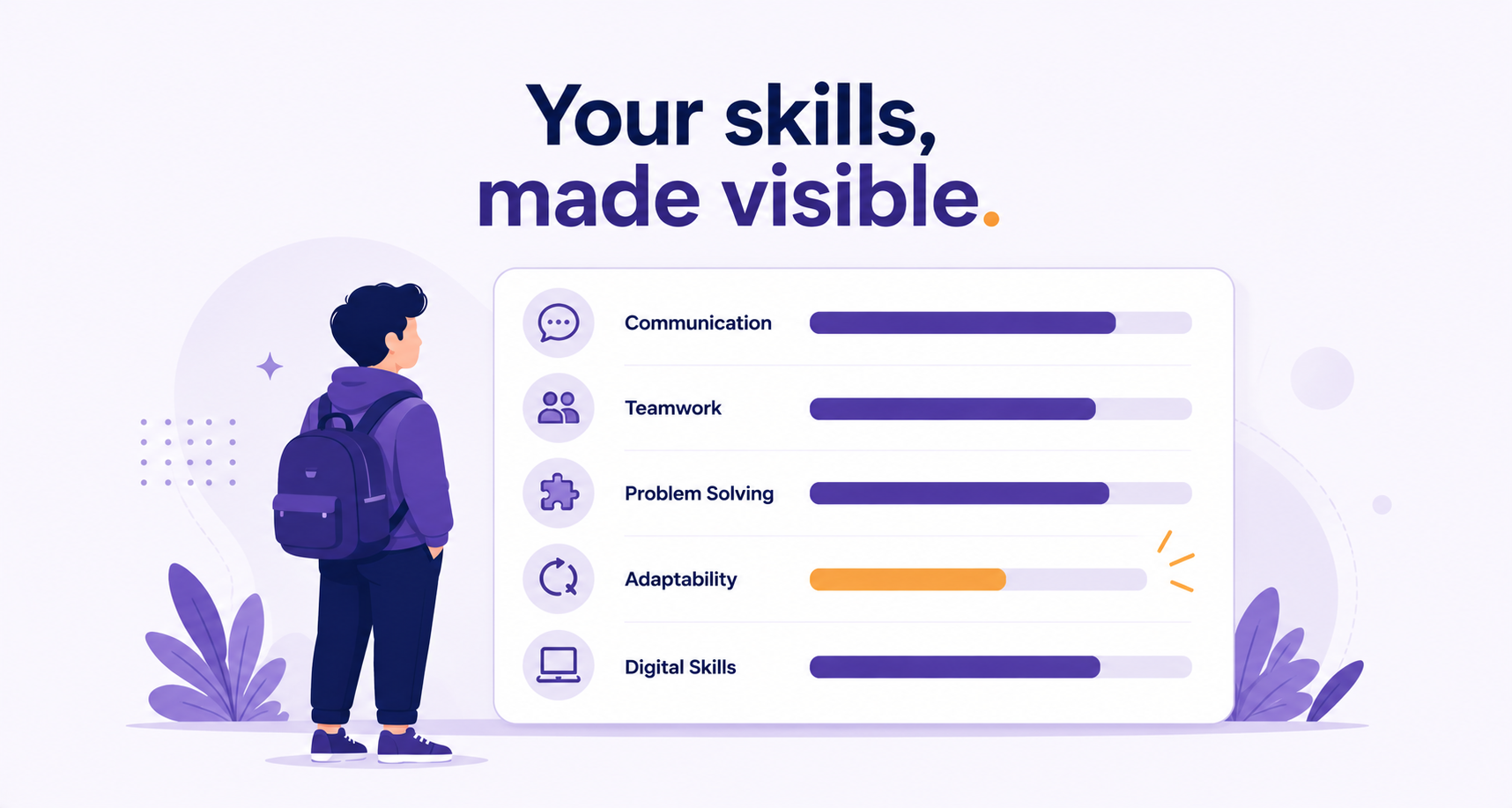
An employability skills assessment measures the general workplace skills that help you get hired and do well in a job, rather than the subject knowledge your exams already measure. Think communication, teamwork, problem-solving, adaptability, and digital confidence. It gives you a picture of where you are strong and where you have gaps, while you still have time to address them.
That last part is what students miss. Most people discover their skill gaps during a job interview, which is the worst possible moment to find out.
What Is an Employability Skills Assessment?
It is a structured way of measuring the skills employers actually hire for. Most versions combine a few methods. You might answer scenario questions, rate yourself against a list of skill statements, or complete short tasks. A teacher or mentor can also rate you on the same scale, allowing you to compare their assessment with your own.
The output is not a pass or fail. A good employability skills assessment produces a profile that shows which skills are already strong, which are developing, and which need attention. That profile is far more useful than a single score, because it tells you what to do next.
Why Does Employability Matter So Much Right Now?
Because the skills employers want are changing faster than most courses are, according to the World Economic Forum's Future of Jobs Report 2025, employers expect 39 percent of the key skills needed in the job market to change by 2030. Nearly two-thirds already name the skills gap as the biggest barrier to their plans.
One finding is worth sitting with. Analytical thinking remains the single most valued core skill, with roughly seven in ten companies calling it essential. Alongside it sit resilience, flexibility and agility, creative thinking, and curiosity and lifelong learning. None of those appears on a certificate, which is exactly why a separate assessment exists.
The consequences are already measurable. The International Labour Organisation’s Global Employment Trends for Youth 2026 report finds that youth unemployment rose to 12.4 per cent in 2025, equivalent to 67 million people aged 15 to 24 who were unemployed. The share of young people not in employment, education or training climbed to 20 per cent, affecting more than 257 million people.
Two findings from that report are worth pulling out. The jobs that traditionally gave young people a way in, including clerical and administrative roles, service and sales work and manufacturing, are shrinking. At the same time, demand continues to grow in knowledge-based fields such as science, health, and engineering. The ILO stresses the importance of young people having access to skills that match how the labour market is changing. This raises a question the report does not answer. How do you know which skills you already have? That is the gap an employability skills assessment is meant to close.
Which Skills Does an Employability Skills Assessment Measure?
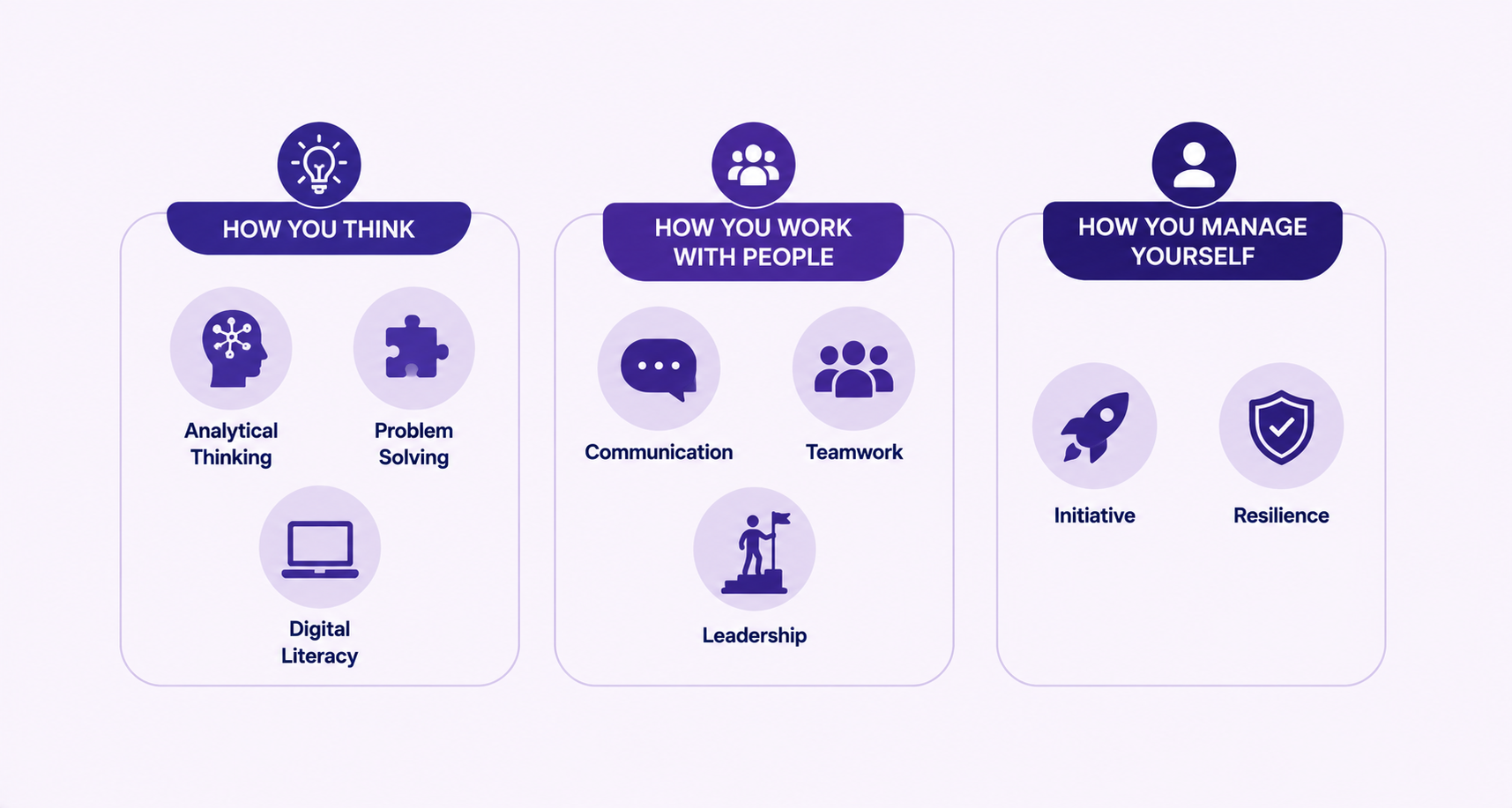
Most frameworks group them into a handful of areas. The wording differs between providers, but the substance is remarkably consistent.
Two deserve a note. Analytical thinking is the one employers rank highest, so it is worth taking seriously, even though it may sound abstract. And digital and AI literacy has moved quickly from a bonus to a baseline.
How Is Employability Skills Assessment Different From Other Types Of Assessment?
Students mix these up constantly, and the difference matters when you are deciding what to spend an afternoon on.
They complement each other rather than compete. A career interest test might point you towards a field. An employability skills assessment tells you what to strengthen so you can get in and do well once you are there.
The Problem With Most Employability Skills Assessments
Here is the honest limitation, and it is worth understanding before you take one.
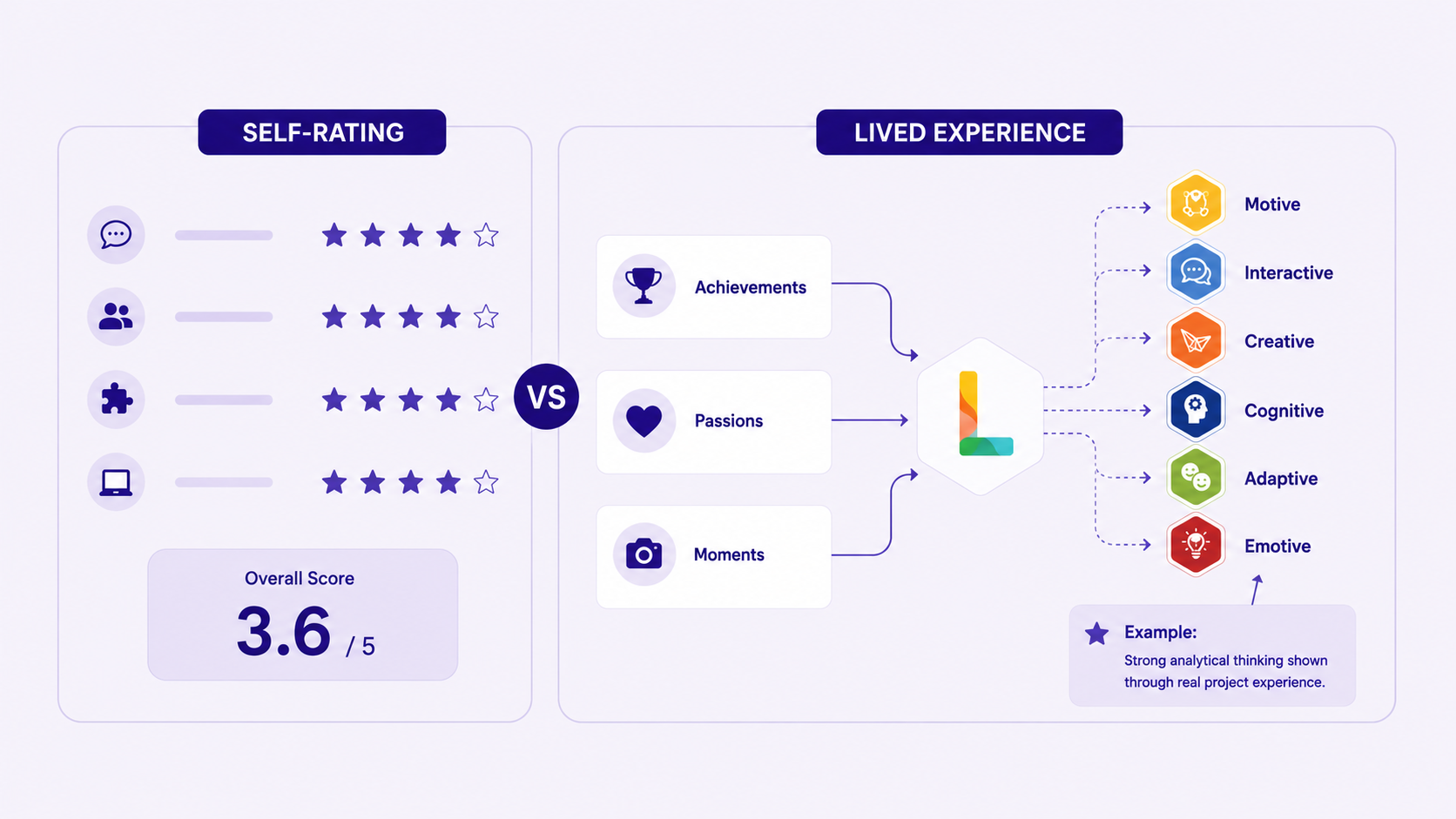
Most employability skills assessments ask you to rate yourself. You read a statement such as "I communicate clearly in group settings," and you score yourself from 1 to 5. That approach has two well-known weaknesses. Students who lack confidence tend to underrate themselves, and students who have never been tested tend to overrate themselves. Either way, the profile reflects your self-perception rather than your actual behaviour.
There is a second, less obvious problem. A self-rating produces a number but no evidence. When an interviewer asks you to describe a time you solved a difficult problem, a score of four out of five is useless. What helps is a specific story about something you actually did.
How LifeVitae Approaches Employability Skills Assessment Differently
This is the gap LifeVitae was built to close. Rather than asking you to score yourself against a list, LifeVitae starts with what you have already lived through and identifies which skills you demonstrated along the way.
The platform is built on the UNESCO-WHO Life Skills Framework and uses AI and natural language processing to turn your experiences into a strengths-based profile. Instead of a questionnaire, you describe three things:
Life Achievements: accomplishments that mattered to you, whatever their scale
Life Passions: the hobbies, interests, and causes you are genuinely connected to
Life Moments: situations you have lived through that shaped how you think and act
From those, the platform surfaces the skills already visible in your own history, then maps them to career pathways that suit them. The result is not a self-rating. It is a profile grounded in what actually happened to you, which means it comes with the evidence attached.
What students get
A strengths profile drawn from lived experience rather than self-scoring
Career pathways matched to those strengths, not to a single test score.
Visible skill gaps, with the remediation needed to close them
Access to books, courses, internships and scholarships that build the gaps identified
A profile that grows as you do, rather than a one-off snapshot
What schools, universities and consultants get
360-degree student profiling that goes beyond marks
A consistent way to track employability across a group of students
Evidence for counselling conversations that would otherwise rely on impressions
Two entry points: LifeVitae Express for fast self-discovery in minutes, or LifeVitae Advance for deeper, longer-term career planning
The approach is used at scale rather than in theory. LifeVitae works with more than 300 partners and over 650,000 students across Singapore, India and Indonesia, with government-backed collaborations in Singapore and Indonesia.
Traditional Assessment or Experience-Based Profiling?
Both have a place. This is the honest comparison.
How Do You Act on the Results?
The assessment is the easy part. What you do next decides whether it was worth doing.
Answer honestly. Inflating your responses produces a flattering profile that helps nobody. The point is to find gaps while they are still fixable.
Read the whole profile, not just the headline. Look at what sits lowest and what sits highest, because both matter for different reasons.
Work on your developing skills. These are the ones sitting between strong and weak, and they usually move fastest because you already have something to build on. A skill at zero takes far longer to shift than one that is halfway there.
Attach each skill to something real: a club, a role in a group project, volunteering, tutoring, a small side project. Skills develop through use.
Record what you did and what changed. This becomes your interview material, and on LifeVitae it becomes part of your growing profile.
Reassess after six to twelve months. One result is a snapshot. Two results show a direction of travel, which is far more convincing.
What Should Parents and Teachers Take From This?
Three things, if you are supporting a student rather than taking the assessment yourself.
First, a low score on an employability skills assessment is information, not a verdict. These skills are learnable, which is the entire premise of measuring them early. Second, where a student’s self-view and an adult’s view differ is usually the most useful conversation available, so look for that gap rather than avoiding it. Third, timing matters more than most people assume. An employability skills assessment taken in the final semester leaves almost no room to act, while one taken two years earlier leaves plenty.
The Takeaway
An employability skills assessment is not another exam to worry about. It gives you a clear picture of your skills, and because you can improve everything it measures with deliberate effort, it gives you room to grow.
Take an employability skills assessment early, be honest, pick two skills rather than eight, and gather evidence as you build them. Employers are not looking for a perfect profile. They are looking for someone who knows their strengths, is aware of their gaps, and has done something practical about them. And if you would rather start from what you have already lived through than from a rating scale, that is exactly what LifeVitae was built to do.
Frequently Asked Questions
What is an employability skills assessment in simple terms?
It is a structured way of measuring the general workplace skills employers hire for, such as communication, teamwork, problem-solving, adaptability and digital literacy. Rather than testing subject knowledge, it produces a profile showing which skills are strong and which need development. Students can then work on the gaps before they start applying for jobs.
Is an employability skills assessment the same as an aptitude test?
No. An aptitude test measures reasoning speed and raw ability, usually through timed questions. An employability skills assessment looks at how you apply skills in workplace situations, including how you communicate, collaborate and handle change. Aptitude tests describe potential, while employability assessments describe readiness.
When should a student take an employability skills assessment?
Earlier than most people do. Taking one in the final year leaves very little time to act on the results. Taking one, two, or three years before graduation gives you room to choose activities, roles and projects that build the specific skills your profile flagged. Repeating it later then shows measurable progress.
How accurate is a self-rated employability skills assessment?
Less accurate than most students assume. Self-rating scales are affected by confidence rather than competence, so underconfident students rate themselves low and untested students rate themselves high. Evidence-based approaches, such as analysing real achievements and experiences, reduce that bias because they start from what happened rather than from how you feel about it.
Do employers actually care about these skills?
Yes, and consistently. The World Economic Forum reports that around 63 per cent of employers name the skills gap as their main barrier to transformation, with analytical thinking, resilience and creative thinking among the most valued skills. Employers repeatedly report that graduates arrive with subject knowledge but without the workplace skills to apply it.
Can you improve a weak employability skills assessment result?
That is the whole point of taking one. These are learnable skills rather than fixed traits. Choose one or two areas instead of trying to fix everything, put yourself in situations that require the skill, and keep a record of what you did and what changed. Reassessing after six to twelve months usually shows clear movement.
Which employability skills matter most to employers?
Analytical thinking tops the list almost everywhere, with around seven in ten employers saying it is essential. After that come resilience, creative thinking, communication, and knowing how to use digital and AI tools. One shift is worth understanding. Automation keeps reducing routine office and administrative work, which makes skills that machines cannot easily copy even more valuable. Employers also expect you to use AI tools sensibly now, rather than ignore them.
How does LifeVitae assess employability skills?
LifeVitae works from lived experience rather than self-rating scales. Students describe their Life Achievements, Life Passions and Life Moments, and the platform uses AI and natural language processing, built on the UNESCO-WHO Life Skills Framework, to identify the skills demonstrated in those experiences and map them to career pathways. The result is a strengths profile with supporting evidence attached that students can use directly in applications and interviews.
Can schools and colleges use an employability skills assessment across a whole group of students?
Yes, and this is where the value compounds. Institutions use group-level profiling to identify which skills students need to improve, provide targeted support, and measure the effectiveness of that support. LifeVitae supports this through LifeVitae Express for quick discovery and LifeVitae Advance for deeper, longer-term career planning, and works with more than 300 partners across Singapore, India and Indonesia, including schools, universities, education platforms and corporate partners.