
Student Career Mapping: How It Helps Students Plan Their Future
Student Career Mapping: How It Helps Students Plan Their Future
Student career mapping is the process of laying out where you are now, where you might want to go, and the specific steps in between. It does not mean choosing one fixed career at a young age. Instead, it helps you explore different career options and understand which subjects, skills, and experiences can lead you towards them.
The point is not to lock yourself into one career decision. It is meant to help you make informed choices rather than move forward without clear direction. Without career mapping, you might choose a course because your friends chose it, only to realise much later that it does not lead to the career you want.
What Does a Career Map Actually Contain?
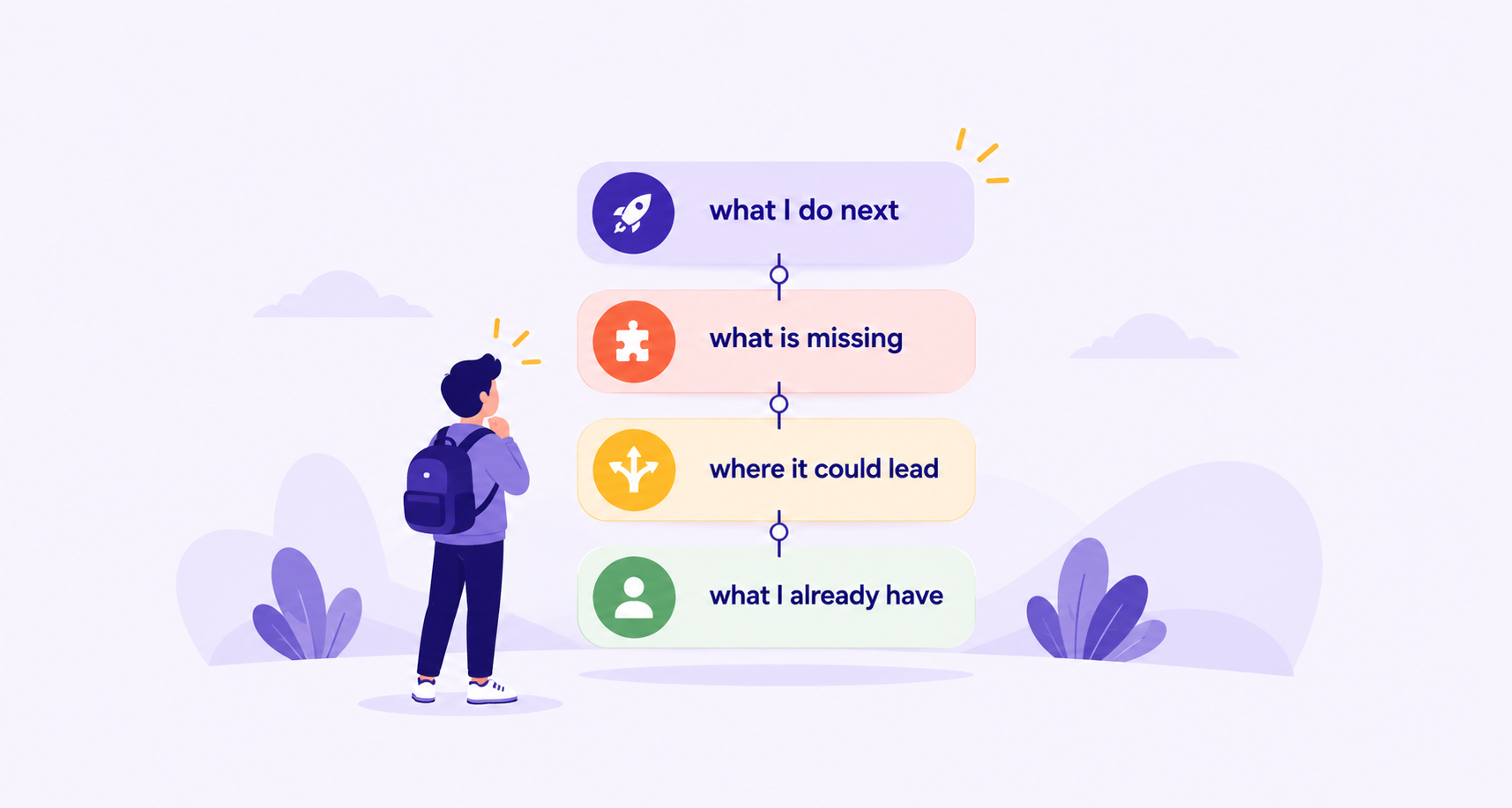
Most explanations of student career mapping stay vague, so here is the concrete version. A useful career map has four layers, and each one answers a different question.
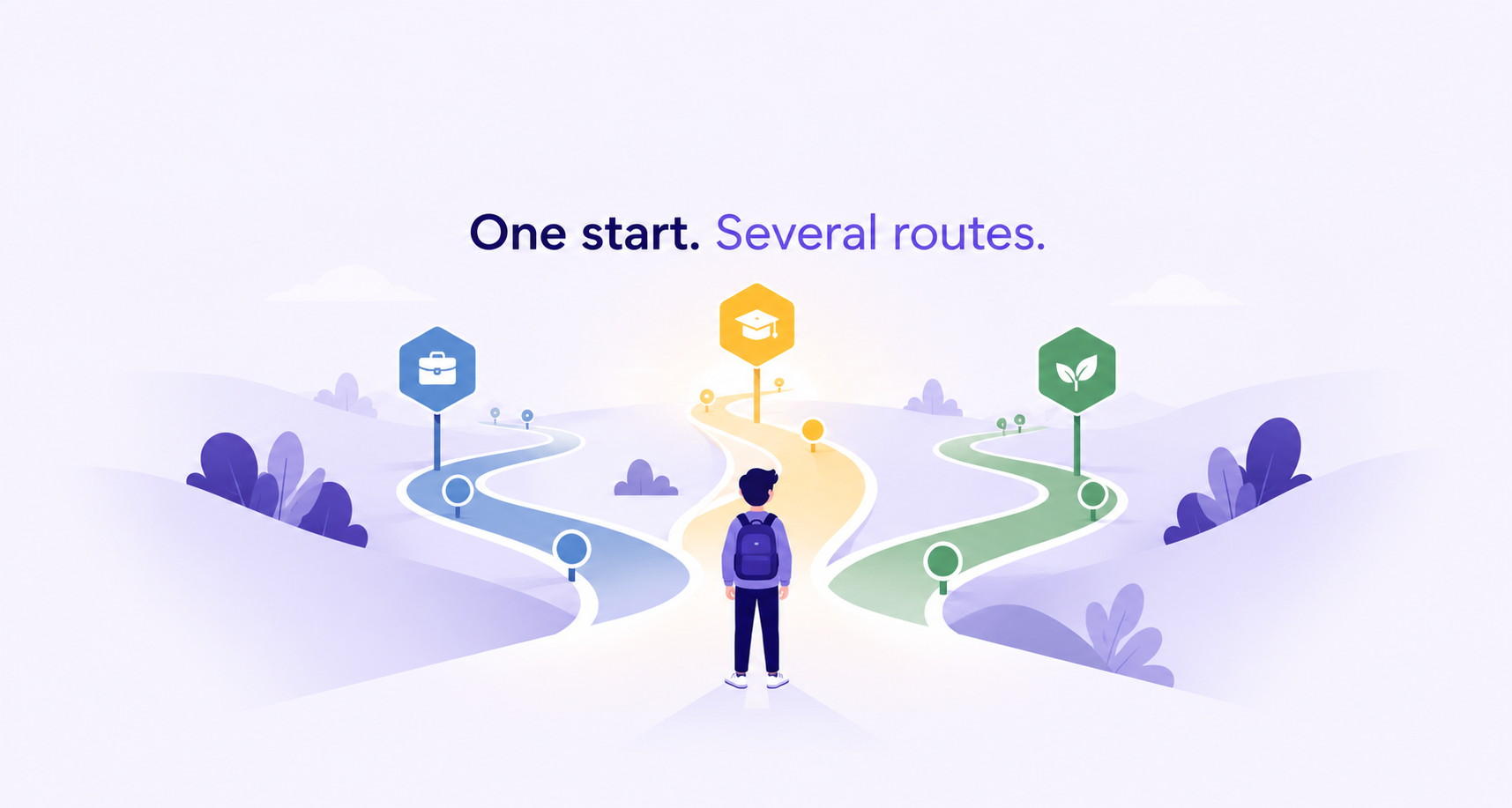
Notice the second row. A map with one destination is not a map; it is a guess. Student career mapping works better when you keep two or three routes open, because the ones that suit you become clearer as you gather experience.
Why Do So Many Students Pick the Same Few Jobs?
This is the part worth understanding before you begin student career mapping because it explains why career plans go wrong even when students work hard.
The OECD’s State of Global Teenage Career Preparation draws on PISA data from more than 80 countries, gathered between 2000 and 2022. It found that student job expectations have barely changed since the start of the century. They are increasingly concentrated in a few occupations. And they bear little relation to what employers are actually hiring for.
This is not a new finding. The OECD's earlier study on the same theme, Dream Jobs, launched at Davos in January 2020 and drawing on PISA 2018 data, reached the same conclusion. By 15, it found, students' career hopes were already narrow, already shaped by social background, and often pointed at jobs facing a significant risk of automation. It also found that career guidance appeared in the data as improving students' readiness to pursue the careers they wanted, yet many had not taken part in the activities that would help. The narrowing starts early, before most students have the information to choose well.
The same OECD report highlights another important finding: career uncertainty among students has increased significantly since 2018. Students who are uncertain about their career direction are more likely to experience weaker employment outcomes later. This means that leaving career decisions until later can have real consequences.
How Is Student Career Mapping Different From a Careers Test?
Student career mapping is often confused with careers tests, aptitude tests, and subject planning. They are related, but they answer different questions, and knowing which one you need saves a lot of time.
A simple way to look at the difference is this: a career test helps you identify career options that may suit you, while career mapping helps you understand the steps needed to reach them. They work best together because knowing what interests you is only the starting point. You also need to understand what skills and experiences those career paths require.
Our guide to the employability skills assessment covers what employers actually hire for. That is the layer most career maps leave out.
The Problem With Mapping Backwards From a Job Title
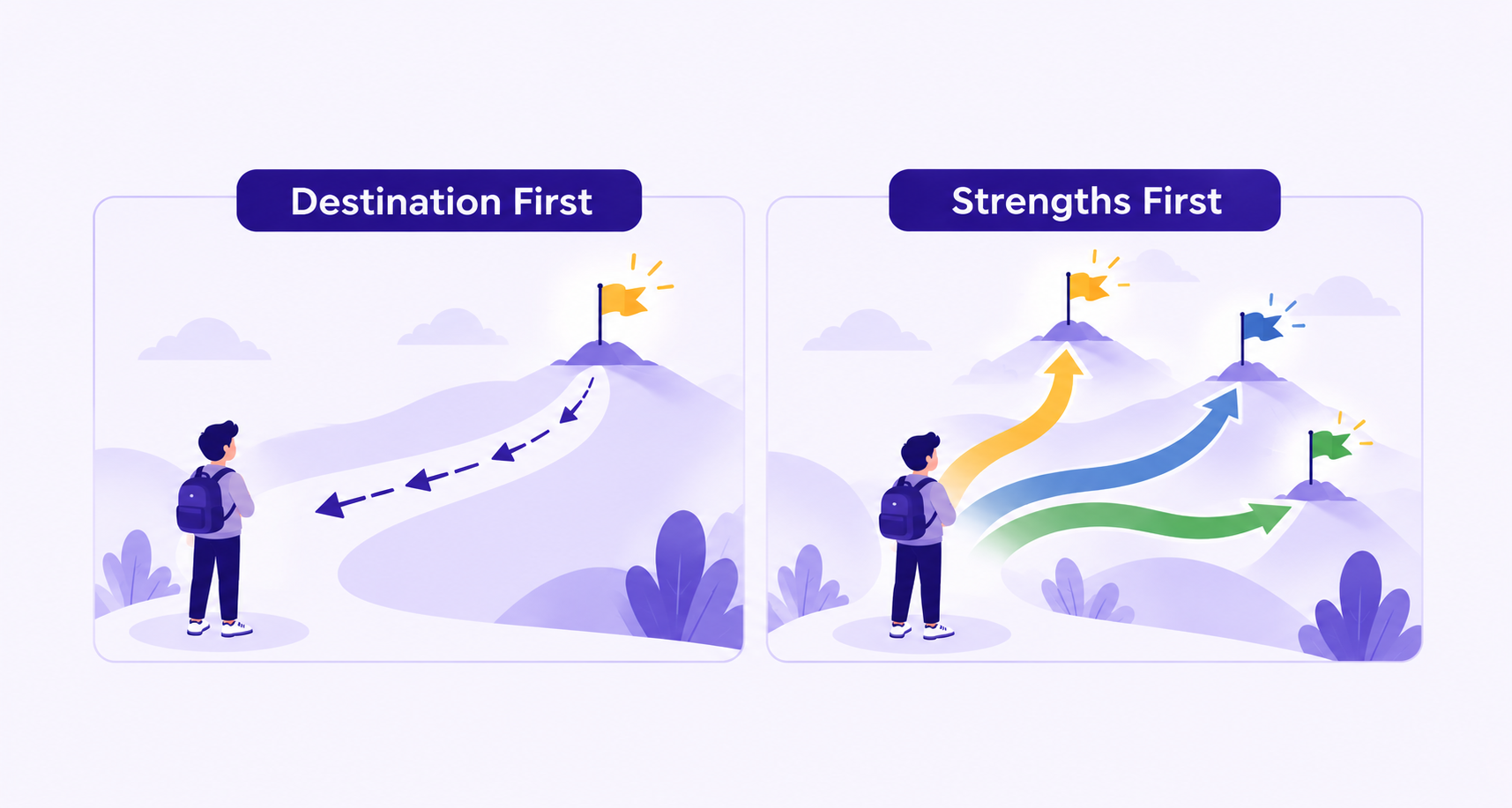
Almost every guide to student career mapping tells you to start at the end. Choose your destination, then work backwards to the steps. But the OECD found that students' job expectations have changed little since the start of the century, are increasingly concentrated, and bear little relation to actual patterns of labour market demand.
In student career mapping, working backwards only helps if the destination is the right one. If you choose a career simply because it is popular or because others are choosing it, mapping out the steps will not solve the problem. It may make you more committed to a choice you have not properly considered.
There is another issue. Starting with a specific job asks students to decide what they want before they have enough experience to know. Many students do not know yet, and that is completely normal. They are not bad at planning. They have just been asked to answer the hardest question first.
How LifeVitae Maps Careers From What You Already Have
This is the gap LifeVitae was built to close. Instead of asking a student to name a destination and reverse-engineer the route, it starts from the evidence they already carry and maps outward from there.
The platform is built on the UNESCO-WHO Life Skills Framework, and it uses AI and natural language processing to turn lived experience into a strengths profile. Students describe three things:
Life Achievements: Accomplishments that matter to you and highlight your successes in life
Life Passions: The hobbies, interests, and causes you are genuinely drawn to
Life Moments: Situations you have lived through that shaped how you think and act
From those, the platform identifies the skills already evident in a student’s history and maps them to aligned career pathways. That reverses the usual order of student career mapping. The student's record is the starting point, and the pathways follow from it.
What students get from it
A starting point built from lived experience, not from a job title guessed at fifteen
Career pathways matched to demonstrated strengths
Visible gaps, with the courses, books, internships and scholarships that help close them
A map that updates as they grow, rather than a document written once and forgotten
What schools and consultants get from it
Student profiles built from lived experience rather than grades alone
Visible skill gaps, with the remediation and career pathways that follow from them
Two entry points: LifeVitae Express for fast self-discovery in minutes, or LifeVitae Advance for deeper, longer-term career planning, built for schools, universities and corporates
The approach runs at scale, not in theory. LifeVitae works with more than 300 partners and over 650,000 students across Singapore, India and Indonesia. Those partners include schools, universities, education platforms and corporates, with government-backed collaborations in Singapore and Indonesia.
Should You Start From a Job Title or From Yourself?
Both approaches to student career mapping exist, and both are used. This is the honest comparison.
Neither is wrong. If you already know your direction and have tested it, mapping backwards is efficient. But the OECD reports that the percentage of students uncertain about their career plans has grown substantially since 2018. For most students, that makes starting from evidence the safer route.
How Do You Draw Your First Career Map?
You can make a rough version this week with a sheet of paper. Student career mapping does not require software to begin. Six steps, in this order.
List what you have already done.
Think about group projects, part-time work, club roles, volunteering, family responsibilities, or anything you have built or organised. This is your starting point, and it is usually bigger than you think.Identify the skills behind each activity.
Do not focus only on what you did. Ask yourself what skills each activity requires. For example, running a school fundraiser could involve planning, persuading and coordinating people.Find three possible career destinations, not just one.
Look for roles that use the skills you already have. Include at least one career you had not heard of a month ago. Exploring unfamiliar options is the whole point.Talk to someone who does each job.
Speak with people already working in those careers. This step can tell you more than online research alone, and there is a good reason why in the next section.Identify the gaps.
For each career path, write down what you still need. This could be a subject, qualification, skill or type of experience.Set three dated actions.
Choose one action for this term, one for this year and one for next year. Be specific and give each one a date. Vague intentions are easy to forget when a busy term begins.
What Actually Improves a Student's Chances?
Of the six steps, one may be more useful than all the others: talking to someone who actually does the job.
Research from the UK charity Education and Employers found that young people who had four or more encounters with employers while still at school went on to earn more and were less likely to be not in education, employment or training. These encounters do not have to be formal. They could be a workplace visit, a talk at school, an hour of work shadowing, or simply a conversation with someone doing the job.
So, if you take one thing from this article, make it this: talk to people who do the work. Half an hour with someone in the job can teach you more than a week of reading about it. Ask how they got started, what surprised them, and what they would do differently. Then ask them who else you should speak to.
How Often Should a Career Map Be Redrawn?
Once a year is a good rhythm, or whenever something important changes.
A map you draw at fifteen should not decide your future forever. As you gain new experiences, discover new interests and learn more about different careers, your plans will shift. Redrawing your map is not a failure. It means the map is doing its job. Each new experience gives you better information than you had the year before.
What Can Parents and Schools Actually Do?
Parents and schools can support student career mapping in three simple ways.
First, open doors to real workplaces.
Help students meet people who are actually doing different jobs. A conversation with someone in the field can be more useful than another career leaflet.
Second, keep their options open.
When a student mentions a career, do not immediately ask whether it is realistic. Instead, ask what other careers might use the same strengths and interests. This helps students discover options they may not have considered.
Third, focus on evidence, not just ambition.
Instead of asking, “What do you want to be?”, ask, “What have you enjoyed and been good at recently?” Their recent experiences can reveal strengths and interests they may not have noticed themselves.
The Next Step
Student career mapping is less about choosing correctly and more about seeing clearly. It connects what you are doing this term to where it could lead. That is exactly the link most students say nobody ever showed them.
Approach student career mapping from evidence rather than from a job title. Keep two or three routes open. Talk to people who actually do the work. Redraw the map each year as you learn more. And if you would rather begin from what you have already lived through than from a list of popular jobs, that is precisely what LifeVitae was built to do.
Frequently Asked Questions
What is student career mapping in simple terms?
It is the process of setting out where you are now, where you could realistically go, and the steps between the two. A good career map has four parts: your current strengths and experiences, two or three possible destinations, the gaps you still need to close, and dated next steps. It is a working document rather than a fixed decision.
At what age should students start career mapping?
Around 14 or 15 is a sensible point to begin, and earlier is fine if it stays exploratory. At that stage, the aim is not to choose a job but to notice what you enjoy and do well. Starting student career mapping early matters because subject choices begin closing certain routes, and a map drawn before those decisions keeps more options visible.
Is student career mapping the same as choosing a degree?
No, and treating them as the same is a common mistake. Choosing a degree is one decision inside student career mapping, usually near the start. The map covers a wider picture: the skills you build, the experience you gather, the people you meet and the alternative routes you keep open. Plenty of careers can be reached through several different courses.
How many career options should a map include?
Two or three career options is a good starting point. Choosing just one can feel like a plan, but it leaves you with no alternatives if things change. Choosing six or more can make it difficult to know where to focus. Two or three options give you enough choice without making things overwhelming. You can build skills that are useful across different careers and narrow down your options as you learn more.
What single activity most improves a student's career prospects?
Direct contact with people who do the work. The OECD found that career activities connecting students with employers and workplaces, such as job shadowing, workplace visits and internships, are most strongly linked to better employment outcomes later. Too few students take part in them, and disadvantaged students least of all, which makes seeking them out genuinely worthwhile.
How does LifeVitae approach student career mapping?
LifeVitae starts from lived experience rather than from a job title. Students describe their Life Achievements, Life Passions and Life Moments. The platform then uses AI and natural language processing, built on the UNESCO-WHO Life Skills Framework, to identify the strengths those experiences demonstrate and map them to matching career pathways. The result is a map that starts with evidence rather than a guess.
Can schools run career mapping across a whole year group?
Yes, and it is more useful at scale than individually, because patterns become visible. Running student career mapping across a year group lets institutions see which strengths are common, where career awareness is narrow, and which students need more support. LifeVitae supports this through LifeVitae Express for quick discovery and LifeVitae Advance for deeper planning, working with more than 300 partners across Singapore, India and Indonesia.